
Whether you need a quick idea for your next campaign or want to draft content in record time, ChatGPT can seriously lighten your workload. But before you start pumping out copy faster than you can say “Is this even ethical?”, let’s chat about some important guidelines.

Think using ChatGPT is cheating? We have to disagree. At Digital Storyteller, we see it as a handy tool— if you play by the rules. We believe you can use AI with integrity and still produce authentic content that reflects your unique voice.

So, how do you make the most of this powerful tool while keeping your marketing efforts above board? Let’s dive into the do’s and don’ts of using AI responsibly. Plus, we’ll share some examples of how we use this tool ethically at our marketing company.

Avoid Plagiarism

It might be tempting to copy and paste paragraphs of what ChatGPT generates, especially when it seems to fit perfectly. 

But trust us, plagiarism isn’t just frowned upon; it’s a slippery slope that can seriously damage your credibility. When you pass off someone else’s words as your own, you risk losing the trust of your audience, who expect authenticity from you. Plagiarism can lead to severe consequences, including legal issues, professional disgrace, and more.

Instead, use ChatGPT to spark ideas, then put your spin on it. Your voice is what matters most, and your audience wants to hear from you, not a machine.

Protect Sensitive Information

When you’re using ChatGPT, remember to keep sensitive information private. Just like you wouldn’t spill the beans about your company’s secrets to a stranger, don’t share confidential data with AI. Keep your private matters private—your business will thank you!

Fact-Check Everything

Fact-check everything—yes, we mean everything. If you’ve ever seen ChatGPT flub some basic math or get a historical fact completely wrong, you know it can’t be trusted blindly. That’s why you need to fact-check everything, no exceptions.

In the marketing world, accuracy is non-negotiable. Using incorrect stats or claims can not only embarrass you but also mislead clients, and that’s a no-go. So, before you roll with whatever ChatGPT serves up, take the time to verify the facts. Trust us, a little diligence goes a long way in protecting your credibility.

Maintain Ethical Standards

Always prioritize ethics in your marketing efforts, especially when using ChatGPT. Know your company’s policies and the industry standards that apply to your work. If you’re using AI for client projects, make sure your clients are informed and agree to it.

Maintaining high ethical standards protects your reputation and builds trust in your marketing practices. Being transparent about how you use AI is essential for fostering positive relationships with clients and audiences.

Use It for Collaboration, Not Replacement

Think of ChatGPT as a helpful assistant rather than a replacement. Sure, it can generate ideas and draft content quickly, but it can’t replicate your unique insights and expertise. Your creativity is what sets your work apart, and that’s not something AI can replicate.

Use ChatGPT to enhance your work by bouncing around ideas or refining drafts, but don’t let it overshadow your own voice. The best results come when you combine your knowledge with AI-generated suggestions, ensuring your content remains authentic and engaging.

How We Use ChatGPT Ethically in Marketing

At Digital Storyteller, we like doing things efficiently. This means using ChatGPT for most members of our team – from proofreading webcopy, SEO keyword lists to brainstorming, here is how we use ChatGPT ethically.

First as a Tool, Not a Crutch

In our team, we treat ChatGPT as a helpful assistant, not a replacement for our creativity. It’s there to support us in brainstorming or refining ideas, but it won’t do our jobs for us. Our unique insights and expertise are what make our work stand out. We leverage AI for some of the legwork, but we always remain in control of the direction and outcome.

Editing and Grammar

ChatGPT is great for proofreading. It helps us polish our writing, ensuring we sound professional instead of like we’re typing with our elbows. We run our content through it to catch any typos or grammatical errors, but we always give it a final read to catch any quirks or style inconsistencies.

Brainstorming

When it comes to brainstorming, ChatGPT can generate ideas quickly and offer angles we may not have considered. A steady stream of suggestions never hurts, whether it’s for blog topics, social media post ideas, or campaign concepts. It allows us to explore various directions without getting bogged down in our usual thought patterns.

We might use it to develop themes for upcoming campaigns or to brainstorm content that aligns with current trends. While we appreciate its contributions, we ensure that our unique voices and insights shape the final output. The goal is to enhance our creative process, not to rely solely on AI-generated suggestions. In short, we treat it as a helpful resource to expand our thinking, not as a substitute for our creativity.

Data Collection and Formatting

ChatGPT can assist in organizing and formatting data to make it more digestible. By transforming raw data into clear, actionable insights, we can save time on busy work and focus on making informed decisions. While we always double-check the accuracy, having ChatGPT streamline this process allows us to prioritize strategic actions over tedious tasks.

But with ChatGPT handling the formatting, we spend less time wrestling with spreadsheets and more time making decisions.

Final Notes

Using ChatGPT with integrity is all about balancing its benefits with your commitment to ethical marketing practices. By being open, avoiding plagiarism, protecting sensitive information, and maintaining high ethical standards, you can take full advantage of what ChatGPT offers without compromising your integrity.

As you bring this tool into your marketing routine, keep in mind that it should enhance your work, not replace your personal touch. Stick to these principles, and you’ll navigate the world of AI successfully. Happy marketing!Read on to learn about the ROI of organic digital marketing (yes, it can be measured!) Then, get in touch with our team to schedule your FREE Brand Storytelling Session.

Storytelling

It would feel morally wrong to write an article about storytelling and not tell you how our company came to be… Digital Storyteller starts with our Founder and Chief Creative Officer, Amanda Rogers.

In 1997, when the actors union was on strike, Amanda taught herself how to code from a book. (Yes, these were the days before WordPress, Squarespace, and WIX—scary times…)

Anyway, Amanda’s martial arts teacher was an 8th degree blackbelt teaching amazing Tang Soo Do in New York City—and had only five students. Amanda knew he needed a website—so she taught herself to write HTML, CSS, and Javascript to try to help him build a studio.

A year later when Amanda moved to Los Angeles, the studio was thriving. In fact, 80% of the students came to him through the website. She was hooked.

After a few twists and turns, Digital Storyteller was born—an organic digital marketing agency in Encinitas, California.

Today, the team has grown from one to nearly 15. On our team, we’ve got content specialists, social media experts, a client success manager, SEO team, as well as a website and graphic design team to continue what Amanda started.

That’s our story.
If you haven’t already recognized the importance of storytelling within a business, we’ll continue on for you. Better yet, we snagged the CEO and Owner of Digital Storyteller to chat about storytelling on camera, Andrew Marr.

What is Storytelling? 

At its core, storytelling is (you guessed it!) about telling stories. Yoast tells us that storytelling is “about using stories to engage your audience, or to make something more clear.”

As humans, we’re wired for story. From each of our early days, it’s likely we recall our parents and the people around us sharing and telling stories. We love to read books and see movies and musicals—why? Because people are addicted to stories.

But what does storytelling look like when it comes to marketing for your business? When it comes to marketing for financial services companies, we see storytelling as making what you do and the services you provide:

  • Relatable 
  • Easy to understand by your audience

Why is Storytelling Important in Marketing?

Storytelling builds trust. Here are some of the stories you can share in your marketing strategy as well as how you can share them:

  • Share your stories on your website
  • Share your origin story
  • Share how you’ve grown
  • Share the challenges your business has faced (How did you overcome these challenges? Did any positives come out?)
  • Share how you help your clients (A lot of companies don’t share how they help their clients. Come on, boast a little!)

As the old adage goes, sharing is caring… Communicating your story with your audience.

A Word of Advice from Our CEO and Owner

So, how important is it to share your company story with your digital followers? (i.e. prospects, people in similar industries, current clients, etc.)

According to Andrew, it’s extremely important if you want to build trust and if you want to build a following. We believe in the power of storytelling. In fact, we start all of our partnerships with a Brand Storytelling Session.

Picture this: You go onto a website. For ease, let’s say it’s a digital marketing agency. You’re looking at their services, considering partnering with this company but you don’t find anything about their story.

There’s nothing about their employees or how the company came to be. Does that make you want to partner with that company even more? No, of course it doesn’t. That’s not the way things go.

For those who feel like it’s weird to talk about yourself or what you bring to the table as a business, for fear of coming off as arrogant or boastful, think about it… It’s your website. That’s kind of the point! 

Let go of the taboo you were taught in grade school, that it’s bad to talk about yourself.

In business, it’s important that you share your success stories and tell people how you help them.

Lastly, share your company culture. People want to know what it’s like to work with you. People wanna know if your employees are happy. Are they going to do a great job for them if they decide to partner with you? Share stories, story after story.

Interested in learning how to build more trust with your prospects and clients? Check out this article on how pricing transparency builds trust.

At Google’s recent Marketing Live event, the tech giant flaunted its strides in generative artificial intelligence (AI).  According to data BrightEdge, “An estimated 84% of queries on Google Search will be boosted by generative AI, eventually impacting more than $40 billion per year in ad revenue.”  Yep, you heard that right.  This is a big f*cking deal for Google, marketers, and users alike.

But amidst all the hype, many businesses and marketers are left scratching their heads, asking, “What the heck is Google up to with AI now? What’s in store for me?”

Let’s dive into what we know for now.

First, Let’s Talk Google’s AI Overviews

Before we dive into the exciting world of AI ads, let’s discuss Google’s latest innovation: AI Overviews. You might have already spotted these summaries at the top of your search engine results pages (SERPs). They’re hard to miss and look a little something like this:

So Google is rolling out new tools for marketers, but the real headline? Ads are about to slide right into those AI Overviews you’ve been seeing at the top of your search results.

Now, these AI Overviews have had their fair share of critics, but Google’s not backing down. They’re betting big on AI-driven search, and they want advertisers to hop on board for the ride. Picture this: you’re searching for tips on removing wrinkles from clothes, and alongside those quick answers, you’ll spot ads for wrinkle-release products from top brands, seamlessly integrated into your search experience.

But that’s not all. Google’s revving up the shopping game with some seriously smart features. Think virtual try-ons and 3D views powered by—you guessed it—generative AI. So, when users browse “summer tops,” they might stumble upon an ad for the perfect blouse from Levi’s, complete with options for different sizes, models, and even body types.

And it’s not stopping there. Google’s exploring all sorts of innovative uses for generative AI in advertising. Take storage space, for example. Imagine users snapping a few pics of your living room and getting personalized ads for the perfect storage unit—all thanks to smart tech making ads more personalized and helpful than ever.

Now that we’ve covered what these changes will look like for consumers, let’s chat about what marketers can expect.

What Marketers Can Expect with AI-powered Ads with Google SGE

Let’s hear what Google has to say about these changes for marketers:

“These new experiences will make Search smarter and simpler, and Search will continue to be a jumping-off point to the best of the web, including your business.” This indicates a significant evolution in Search, with implications for businesses and advertisers.” 

The introduction of the Search Generative Experience (SGE) within Search Labs is particularly intriguing. This feature will serve as a platform for accessing Google Search experiments. Google demonstrated that ads will now appear both above and below this new experience.

Just like other digital advertising platforms, Google is pushing advertisers to embrace generative AI for creating ads. They’re making it easier for advertisers to stick to strict brand guidelines by allowing custom colors, fonts, and specific image references in Performance Max campaigns. Plus, Google is beefing up its AI-powered image editing tools, letting marketers seamlessly add new elements like a classy oil painting to their ads.

But here’s the catch: generative AI works best with top-notch inputs and careful monitoring. Google is launching Google Ads Data Manager to help small businesses manage their data better. This tool is designed to assist advertisers in handling various data sources and vendors more efficiently. With this move, Google is making AI-powered advertising more accessible and manageable for everyone.

According to Marketing Dive, “Healthcare, e-commerce and B2B technology industries are estimated to be impacted the most by the technology.”

How can marketers respond to Google SGE? Let’s take a look at some options.

Impact of Google SGE on Search Ads and Marketing Strategies

The introduction of Google SGE is set to shake up search ads and the wider world of digital marketing. With its advanced search capabilities, ads can now be finely tuned to match both the keywords and the context in which they appear. This level of detail means we can create ad campaigns that really speak to each individual user, potentially boosting conversion rates and the overall effectiveness of our online advertising efforts.

For marketers, this means a change in approach is needed. We have to think not just about the keywords themselves but also about the reasons behind a search when crafting our ads. It also puts a greater emphasis on producing top-notch content that genuinely aligns with the interests and needs of the user. As SGE makes search smarter, simplistic or generic ads won’t cut it anymore. Audiences now expect ads that are highly relevant and personalized to them.

Further, the real-time performance analysis and adjustment capabilities of Google SGE will allow us to fine-tune our advertising strategies more efficiently. By making smart use of these new tools, we can ensure our ads not only hit the mark but do so in a way that’s both resource-efficient and highly impactful.

Need Help with Your Marketing?

If you’re eager to stay ahead in digital marketing and make the most of the latest technologies like Google SGE, reach out to Digital Storyteller.

As a digital marketing agency, we know firsthand the challenges and opportunities that businesses face when it comes to budgeting and executing effective marketing campaigns.

We bring fresh, innovative ideas from our kick-a** creative team, all rooted in a relationship built on trust. Because that’s the essence of digital marketing – it’s not just about numbers and algorithms; it’s about connecting with your audience authentically and leaving a lasting impact.

Interested in learning more about us? Let’s chat.

Then, read on to learn The Four Main Types of Ads and What Works for B2B Businesses.

AI has been making waves in recent months, with advancements in technology fueling discussions and piquing interest across various industries. From sophisticated writing assistants to innovative image editors, it feels like AI is everywhere. But for many marketers, diving into the world of AI can feel a bit daunting.

Questions start swirling: “Will our content sound too robotic if we use AI?” or “Can people tell if our blogs were written by a machine?” It’s natural to have these concerns when you’re thinking about bringing AI into your marketing game.

But we’re here to tell you – don’t be scared of AI, embrace it. AI isn’t here to take over our jobs—it’s here to make them easier. Sure, there might be a learning curve, but once you get the hang of it, AI can be a game-changer for your marketing strategy. 

So, let’s tackle those worries head-on and see how we can make AI work for us, not against us.

AI Can Get You 60% of the Way There

Let’s address the elephant in the room: the fear of sounding robotic or artificial. It’s a valid concern, but AI isn’t here to replace human creativity entirely. At Digital Storyteller, we’ve found that AI can take us about 60% of the way. It helps us generate ideas, outlines, and even assists in rewriting awkward sentences.  But, we still need writers to edit, fact check, and make everything sound human. 

Insider tip: Also have your writers double check for words that are especially known to be AI. Our running list includes words such as: landscape, demystify, realm, unveil,  crucial, and ending with “in conclusion.” Now that we told you the insider secret, see how many blogs begin with “In the complex landscape of…” 

How AI Can Streamline the Writing Process

Writing can be a time-consuming process, but with the help of AI, we can streamline various aspects of content creation to make it more efficient and effective.

Topic Generation

Gone are the days of staring at a blank page with no idea where to start with topics for blogs. How do we begin writing with the AI process at Digital Storyteller? We enter data and generate a list of potential topics. From there, we can propose multiple options to our clients or choose the strongest topics ourselves.

Improving Research

AI-powered tools can quickly gather and analyze vast amounts of data from various sources, providing writers with valuable insights and information to support their writing. For example, AI can scan through relevant articles, studies, and industry reports to gather data on a specific topic, saving writers hours of manual research time.

Enhancing Creativity

AI can enhance creativity by generating creative ideas, suggesting unique angles, and providing inspiration for engaging content topics. By analyzing existing content and identifying patterns, AI can propose innovative approaches to storytelling and content creation, helping writers overcome creative blocks and generate fresh ideas.

Automating Repetitive Tasks

Tasks like formatting, proofreading, and fact-checking can be automated using AI, freeing up writers’ time to focus on more high-level aspects of content creation. AI-powered tools can automatically correct grammar and spelling errors, ensure consistency in writing style and tone, and even suggest improvements to sentence structure and clarity.

Challenges with AI and How to Overcome Them

As beneficial as AI can be in streamlining the writing process, there are also challenges that businesses may face when implementing AI-powered tools. 

However, with the right strategies and approaches, these challenges can be overcome.

Adoption and Integration

One of the primary challenges is the adoption and integration of AI technology into existing workflows. Many businesses may be hesitant to embrace AI due to concerns about complexity, cost, or resistance to change. To overcome this challenge, it’s essential to provide training and support to employees, clearly communicate the benefits of AI, and gradually integrate AI tools into existing processes.

Quality Control

Another challenge is ensuring the quality and accuracy of content generated by AI. While AI can assist in generating ideas and content, it’s crucial to maintain human oversight to ensure that the content aligns with brand standards, is factually accurate, and resonates with the target audience. Implementing quality control measures, such as manual review and editing, can help maintain the integrity of the content.

Creativity and Originality

AI-generated content may sometimes lack creativity and originality, leading to generic or uninspired writing. To overcome this challenge, businesses should use AI as a tool to supplement human creativity rather than replace it entirely. By combining AI-generated ideas with human creativity and expertise, businesses can produce more engaging and impactful content that resonates with their audience.

Ethical Considerations

Ethical considerations, such as bias in AI algorithms or concerns about data privacy, can also pose challenges when using AI in content creation. It’s essential for businesses to prioritize transparency, accountability, and ethical AI practices to ensure that AI-powered tools are used responsibly and ethically. This may involve regular audits of AI algorithms, data privacy protections, and ongoing monitoring of AI-generated content.

By addressing these challenges proactively and implementing best practices, businesses can leverage AI effectively to streamline the writing process, improve content quality, and drive greater success in their marketing and communication efforts.

Final Notes

By capitalizing on the benefits of AI in marketing while remaining mindful of the implementation challenges, businesses can unlock new opportunities, drive growth, and stay ahead in their industry.
Interested in finding out more? Read on to learn about the ROI of organic digital marketing (yes, it can be measured!) Then, get in touch with our team to schedule your FREE Brand Storytelling Session.

girl on video using camera on tripod to build her digital marketing strategy

Are you a business owner? If the answer is yes, please tell us you’re incorporating video into your digital marketing strategy… If you’re not, you’re missing out on a huge opportunity. 

Why? Because video is crucial to showcasing your brand and ultimately, getting more clients. And what business owner doesn’t want more clients? After you’re done with this article, circle back to find out how to attract the right clients.

But for now, we’ve got Andrew Marr, Owner and CEO of Digital Storyteller on camera to discuss the importance of using video in your digital marketing strategy.

Let’s hear what this ranting Scot has to say.

Why is Video Important to My Digital Marketing Strategy?

So, why is video important? At Digital Storyteller, we love our metrics and statistics. (Our awesome SEO manager, Devin Aubert, however, is on another level when it comes to statistics love!)

This considered, we thought we’d demonstrate the importance and popularity of video with some stats from Techjury. Let’s take a look at the booming industry. Did you know…

  • “Video is the number 1 source of information for 66% of people.
  • Over 500 million people watch Facebook videos every day.
  • More than 75% of all video views come from mobile devices.
  • The global video market was valued at $39.61 billion in 2018…” (Imagine where it’s at now!?)
  • “YouTubers upload 300 hours of video content to the platform every minute.
  • 93% of businesses gain new customers as a result of branded video content.”

The point is so many individuals watch videos nowadays.

In fact, our owner and CEO Andrew admits to watching at least 50 to 100 short videos a day through Facebook, Instagram, and LinkedIn. Hey, it’s where his enjoyment sits!

But it’s not just cute puppy videos that grab his attention, Andrew reminds us.

“I learn from video. Most clients in the financial services world, the clients that we work with, have a hard time with video, and understandably so…”

Why? Truth is, it’s hard to sit in front of the camera and talk, especially about ourselves!

Today, Andrew says, your digital marketing strategy must include not only long-form blogs, newsletters, white papers, etc. but also videos. Why? If not, you’re missing out on a huge group of viewers, and therefore, prospects.

How Can I Get Started?

So, if you’re a business owner, you might be wondering… “How do I get started with this video stuff?”

Don’t worry, you don’t have to reinvent the wheel.

All you need in terms of video length is 30 seconds to a minute.

“But what do I talk about?!” Don’t worry—Think about the questions you receive over and over as a business owner.

For Andrew, these questions include the following:

  • Why should I outsource my marketing?
  • How long does it take to see an ROI when it comes to organic marketing?
  • Why does Digital Storyteller specialize in financial services?
  • How much does your marketing cost?
  • What is organic content marketing?

So, think: What are the five main recurring questions you get? Then, sit down and answer those questions.

Make your videos short and to the point.

If you’re not answering a question that you frequently get from clients, consider telling a story instead. You can tell a story about…

  • How your business helped a client
  • Someone on your team

You can even ask a client to record a video testimonial for you if you’re not quite ready to jump in front of the camera yourself! Here’s how to ask for a client testimonial.

Still Not Convinced?

Video is social media’s favorite form of content right now. By using video, you will increase your traffic, up your engagement, AND people will simply get to know you better by seeing your face, hearing you talk, and getting to know your personality!

Read on for more information about boosting your engagement via video in our article “Want to Connect with Your Prospects? Use Video.

How to Record a Great Video

Need more guidance? Not sure what to wear in the video? Or, how to position your camera? Read our article “How to Record a Great Zoom Testimonial” for all the answers you seek.

PS: These tips apply just as well to non-Zoom video recordings! Happy recording!

tracking marketing kpis

SEO, CTA, KPI … The list of terms you need to know for your marketing strategy seems to go on and on. We’re here to help break it down and make it easy for you to understand. Keep reading for our full guide to marketing key performance indicators (KPIs).

What is a KPI?

KPI stands for key performance indicator. They are a way to measure performance over time. Following certain metrics over time can help your business reach milestones, gauge processes, and provide insight to make better business decisions. 

What Marketing KPIs Should You Track?

Tracking the right key performance indicators can provide a holistic view of how  your business is performing. 

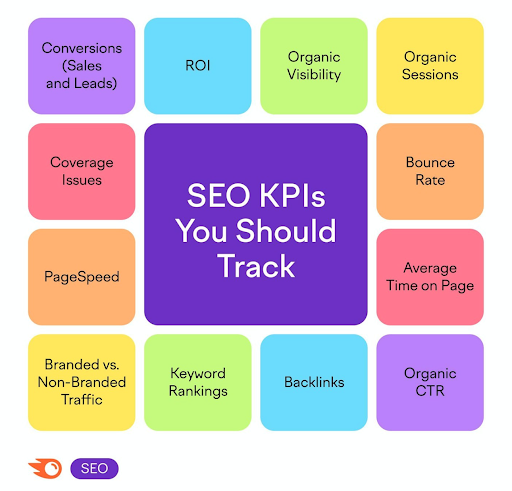
We, like Semrush, believe that these are some of the best KPIs you should be tracking:SEO KPIs

  1. Conversions: How many of your site visitors are qualified leads? How many of them convert to closed sales? 
  2. ROI: Return on investment is a metric that tells you how profitable an investment is/was, in this case, likely how profitable your marketing investment was.
  3. Organic Visibility: How are people finding your site? Are you showing up through organic search?
  4. Organic Sessions: How many users are finding your site through an organic search? 
  5. Bounce Rate: How quickly are users leaving your site after visiting? If your site is not user-friendly, loads slowly, or doesn’t provide the information your users are looking for, they might exit the site after viewing only a single page. 
  6. Average Time on Page: How long are your users spending on your site pages? Pages with more content, such as blogs or videos, typically tend to drive longer time on-page.
  7. Organic CTR (click-through rate): Does your site have clear calls to action (CTAs)? How often are users clicking buttons or links on your site? Which buttons/links are you driving them to click?
  8. Backlinks: Sites with higher authority are more likely to see increased backlinks. If your site provides valuable, authoritative information that users find helpful, and useful, they may be more likely to link to it from their own sites. This helps drive referral traffic to your site and continues to support authority improvements. 
  9. Keyword rankings: Keyword rankings are the primary driver of organic search traffic. Targeting specific keywords relevant to what your business does is critical to increasing organic search traffic. It’s important to track keywords in two ways: total ranking keywords, and keyword ranking positions. 
  10. Branded vs. Non-Branded Traffic: Branded keywords are directly related to your unique business. For our brand, this would include keywords such as “Digital Storyteller,” “Digital Storyteller marketing agency,” “Andrew Marr,” etc. Non-branded keywords are those that your site ranks for that are not specific to you, such as “digital marketing,” “social media management,” and “search engine optimization.”
  11. Page Speed: Page speed is a huge determinant of how your site performs. According to backlinko, the average page loading speed is 10.3 seconds on desktop and 27.3 seconds on mobile. If your site takes longer than this to load, chances are your user won’t wait and will instead visit a competitor’s site instead. Safe to say we’ve become a pretty impatient society … 
  12. Coverage Issues: Performing site audits can ensure that your site is functioning properly and that Google is indexing and reading your site as it should be. Google Search Console is a critical tool in identifying coverage issues and can help you solve any issues that you find.  

How to Develop your Marketing KPI Strategy

Your business’ marketing KPI strategy should be unique to your business needs. Sure, you can glean ideas from other similar business models, but tailor yours to help guide you where you want to go. 

Here are a few tips on how to develop your marketing KPI strategy.

  1. Define your KPIs- Which specific KPIs will your business track? How will you collect the data and how often will you track shifts? 
  2. Use the SMART Method- KPIs should be Specific, Measurable, Attainable, Realistic, and Time-Bound. For example, “Onboard 7 new clients in the next 12 months.”
  3. Keep your KPIs clear- Your team should understand your KPIs and how to act on them to make decisions that ultimately lead to reaching your goals.
  4. Revisit your plan- Sometimes plans need to change. Revisit your KPI strategy to make sure the strategy is still working for you. Maybe you need to adjust a few action items based to keep propelling forward in the right direction. 
  5. Don’t overdo it with KPIs- Try to avoid doing too much, too quickly. With access to a plethora of data, it can be easy to try to measure every little thing. We recommend using the information to stay on track with your most important targets- however you define them. This will help you avoid KPI overload. 

See an example below of how we at Digital Storyteller keep track of the important KPIs to our business strategy.

scrolling on instagram burgers in background

Social media algorithms, we’ve written about them before. It seems, however, that with every month, week, and sometimes daily, Instagram is implementing new changes.

Instagram has recently implemented a number of changes to its algorithm that have crashed engagement across nearly all accounts.

The most common complaints we hear? “I never see my friends’ posts anymore,” “I think I’m shadowbanned…” “My engagement sucks lately.”

We’ve heard it all and we feel your pain! Let’s talk about some of the recent changes Instagram has implemented and address some of these concerns.

What’s Going on with The Instagram Algorithm?

What better way to dissect the algorithm than to look at a blog post that Adam Mosseri, head of Instagram, wrote titled “Shedding More Light on How Instagram Works”?

Most importantly, Mosseri wrote that one of the main misconceptions about Instagram is the existence of “The Algorithm.”

“Instagram doesn’t have one algorithm that oversees what people do and don’t see on the app,” says Mosseri. “We use a variety of algorithms, classifiers, and processes, each with its own purpose.”

There’s a ton more good stuff and information on how the Instagram algorithm works (or lack of!) in the actual article, so check that out if you’re interested.

For now, let’s talk about some of the recent changes Instagram has implemented that might affect your content being seen or not.

Chronological order is back!

It’s about time! Instagram’s @Creators account finally announced the return of chronological order.

Back in the day—in 2010, to be exact—the Valencia filter ran rampant and the app itself looked like a neutral-toned vintage camera. Moreover, your home page was a single stream of photos that were sorted in chronological order.

Viewing posts in chronological order, however, was a feature that was removed in 2016. If you ask some, this choice nearly started WW3 (Just kidding … Kindof).

But flash forward to today, it’s back!

“You’ve been asking, and we’ve been listening! 👀” is what @creators captioned the announcement.

Following and Favorites

Instagram decided to take things a step further.

Instead of reverting back to solely chronological order, Instagram now offers three options to view your feed:

  • Home
  • Favorites
  • Following

Here is a brief description of what makes each different.

Home: According to @creators, “home” refers to the feed you’ve gotten used to. This feed will “remain a mix of content from people you follow, recommended content you may like, and more.” Home will remain your default view when you first open the app.

Favorites: Your “favorites” feed will show you the latest posts “from a list of up to 50 specific accounts that you choose.” This might include your best friends, favorite creators (including Digital Storyteller of course), or other favorite accounts that you follow.

Following: Just as it sounds—the “following” feed will show you posts from only accounts that you follow.

Are You Using All of Instagram’s Features?

Over the past five years, Instagram has launched a ton of new features, including reels, stories, IGTV, and even shopping.

We’ve noticed that sometimes it feels like Instagram either rewards or punishes accounts based on your usage of the app as a whole. The bottom line? Instagram wants you to use and try all of its features. 

Depending on your business or goals, your digital marketing strategy might include a combination of:

  • Standard posts
  • Reels
  • Stories
  • IGTV videos
  • Shoppable posts

Consistency is Key

The algorithm favors consistency and patterns. Find out when your target audience is most active, and tailor your posting schedule toward that. At Digital Storyteller, we do this with ease using the scheduling platform, Metricool. Of course, there are various alternative scheduling platforms and tools that can be used similarly as well.

A Quick Rundown of Each Social Media Platform

Lastly, it’s important to know which social media channels are best suited to help you attain the unique needs and goals of your business. That’s why we’re sharing a brief rundown of what each platform can be used for when it comes to your business. So, what the heck does each of them do? Speed round, go!

Instagram

Instagram is great for building engagement and sharing culture. That means taking pictures of your team at events, showing off your pets, and happy hours and posting them!

When an Instagram user visits a business’ Instagram, they want to see the people behind the business. Show them who they get to work with when they decide to buy your product or become a client.

Facebook

Facebook is for your grandma… Just kidding, kind of!

Facebook, in the business world, is a largely pay-to-play platform. In simple terms, if you’re not putting money behind your Facebook efforts, chances are not many people will see your content. Boosting a specific post to your Facebook audience can attract thousands of impressions, whereas organic content doesn’t typically reach the same levels of performance.

(Please note: We’re not suggesting that you dedicate your entire marketing budget to your Facebook page, but putting $50 behind a post here or there can significantly support your Facebook performance).

LinkedIn

LinkedIn is a professional platform, which means it’s probably not the best-suited platform to share your family photos or pictures from your latest island vacation.

LinkedIn is a great platform to help you build authority and build a professional network. Chances are, LinkedIn is your best bet if you’re looking to identify qualified leads via social media. It’s also a great way to gather expertise from established experts in your industry.

Twitter

In a nutshell, Twitter is for politics, news, and funny one-offs (think: memes, GIFs, recaps of the Oscars…)

A Final Word

We know that managing your business’s social media presence can be a lot to keep track of on top of running your business. That’s why we recommend you pass on the work of crafting a killer digital marketing plan to our team of experts at Digital Storyteller.

Not ready to make the jump yet? Let’s get REEL instead! Check out this article on how Instagram reels support your social media strategy. Then, shoot us a message.

How to attract the right client

So, you’re a business owner looking to get more clients? (Trust us, you’re not the only one!)

Every business owner ever:

But hold on – before you go all Heidi Klum on us and start looking to get MORE clients… Have you taken a minute to consider how to attract the right clients? Yes, the right clients. After all, you don’t want to be marketing your products and/or services to every person you walk by…

Not sure where to start? Lucky for you, we’ve got Andrew Marr, CEO and Owner of Digital Storyteller on camera to chat about how to attract the right clients.

Let’s see what he has to say.

Who is Your Ideal Client?

Clients, for any business owner, are obviously extremely important. Without clients, you’d have no business! (But you already knew that).

This considered, building a successful business and getting more clients is most likely one of your primary goals as a business owner.

Before we jump the gun and talk about getting more clients, however, it’s important to first discuss who the right clients are for you. How can you attract the right clients to your business?

Identifying the Perfect Client

The question isn’t, “Do you want more clients?” Of course, you do! The number one thing is, have you identified your perfect client?

Then, after you’ve identified your ideal client, think: Are you willing to create strategies around that particular client?

Our Perfect Client at Digital Storyteller

At Digital Storyteller, we focus on marketing for financial services companies. The realm of financial services ranges from commercial insurance to wealth advisories, commercial real estate firms, the list goes on.

While we love whisky, chardonnay, puppies, and tacos, we don’t market for companies that have anything to do with these elements. Why not? Because we’ve identified our perfect client (financial services clients) and unfortunately, whisky, chardonnay, puppies, and tacos have nothing to do with this industry (a little sad, right?)

We know it’s difficult not to accept whatever business walks through the door. It’s important, however, to hone in on who your ideal client is and not accept anyone else apart from this target audience.

So, to attract more clients, you have to first, figure out who your perfect client is. Put your energy and resources into that.

Interested in meeting one of our ideal clients? Check out this spotlight we did on our client Frank Crivello, founder and CEO of SBMA Benefits.

Why is Organic Marketing Great for Financial Services Companies?

When you think of ‘marketing,’ what do you think of?

Chances are the first place your head goes is to advertising—billboards, television commercials, magazines, Instagram ads, the list goes on.

We don’t blame you! We are bombarded by ads every day. In fact, did you know research shows every day the average person encounters between 6,000 to 10,000 ads? This is a massive jump, considering that back in the 70s, “it was reported that the average person saw between 500 to 1600 ads per day.”

But remember, advertising is just a small piece of the marketing pie. Although paid ads have their time and place there’s a better way to market yourself. (Psst… It’s called organic marketing).

Amanda Rogers, Founder and Chief Creative Officer at Digital Storyteller, talks about why organic marketing is great for financial services companies (and all companies for that matter!)

Let’s get into it.

The Mistake Many Business Owners Make

If you’re in the business-to-business (B2B) space and are trying to get more clients under your belt (as one does!), your thought process about doing so might go something like this:

  • “I’m going to put out some ads and tell people what I do.
  • Then, they’ll come to my website.
  • Then they’ll give me a call.
  • And BOOM! I’ll get clients.”

Sigh… if only it were that simple! In today’s world, paid advertising alone is not enough to attract the right clients. So, what else do you need in addition to occasional paid advertisements? Enter, organic marketing.

Paid vs. Organic Marketing: What’s the Difference?

Let’s make this simple.

Ads are about building awareness; organic content is about building trust. While different, BOTH are important to building a successful digital marketing strategy for your business.

As Amanda shares, there are often situations in which the two overlap even. “There are elements of organic content that also build awareness.” For example, integrating boosted posts into your organic social media strategy.

What Does Organic Marketing Actually Do?

Most importantly, you need to know the primary benefit of organic marketing: building trust. Organic marketing might include email marketing, a thought-out video strategy, blog content, etc.

The greatest benefit of all of these things, however, is that organic marketing increases the feeling that people have of knowing and trusting your brand.

Don’t get us wrong, there are certainly strong benefits of paid ads (which you can read more about here) but it shouldn’t be the only marketing effort your business is focused on.

However, as Amanda puts it, “If and when you do decide to do ads, [if] you’ve been doing a strong organic digital marketing push,” the benefit will be much greater.

  • Your domain authority will be higher
  • Your ads will show up in the top three search results
  • And most importantly, your ads will be supported by showing up on that first page of Google with an organic result

“This reinforces in the viewer’s mind, not only do I see their ad, but I also see that they are legitimately what I’m looking for,” says Amanda.

And the best part of all? If you’re paying less for ads, you have more money left over that you can spend on wine! What better motivation is that?

So, are you ready to save money on ads so you can spend it on wine? Us too. At Digital Storyteller, we specialize in organic marketing for financial services companies. If you’re looking for a digital marketing agency that will grow your business better than just pushing paid ads, contact our team today.

Outsourced Marketing

Outsourcing isn’t as complicated as it sounds. When you outsource your digital marketing services, you save time, energy, and money. Here are six benefits of outsourcing marketing.

How Do You Measure the Success of Your Digital Marketing

So, you finally caved and implemented a kick*** digital marketing strategy for your business. Congratulations, that’s amazing!

But how do you know if it’s working? How do you measure the success of your digital marketing strategy? It’s an important question and is often an inquiry that Andrew Marr, CEO & Owner of Digital Storyteller, gets from prospects and clients.

He’s here to answer it today. Watch Andrew’s video below to learn how he measures the success of a digital marketing strategy. Let’s get started.

The Most Important Question to Ask

Whether or not your digital marketing strategy is successful or not comes down to one main question: Are you getting more clients?

If the answer is no, it’s time to reevaluate your strategy. Here’s how you can do that.

Key Performance Indicators (KPIs)

We’ve all heard of KPIs.

Digital marketing KPIs, according to Digital Dot, are “quantifiable metrics that you can use to measure and monitor the partial and overall success of your digital marketing strategy.”

KPIs help to establish clear goals regarding campaigns and can be used in a variety of marketing approaches, including:

  • “Search Engine Optimization (SEO)
  • Pay Per Click Advertising (PPC)
  • Social Media Marketing
  • Email Marketing”
  • And more

Here are some of the most important KPIs to track when it comes to your digital marketing strategy.

How to Measure the Success of Your Digital Marketing Strategy

At Digital Storyteller, we conduct monthly and quarterly reporting for all of our clients. These reports help us show clients how we’re moving the needle, what’s working for them in their digital marketing strategy, and where we can shift to improve.

Below are some factors we evaluate:

Authority Score

Authority score, according to Semrush, is their “compound domain score that grades the overall quality of a website or a webpage.” Your score can range anywhere from 0 to 100. The higher the score, the more credibility a site typically has. Obviously, an authority score of 100 is #goals, but realistically, a score ranging from 32-48 is where you’ll see a strong organic marketing score lie. 

This figure is determined by a few key factors including:

  • Backlinks
  • Organic keyword rankings
  • Site health
  • Site age
  • Among many other factors

Because of these factors, authority score takes time and consistency to grow. After all, you can’t grow your authority score overnight– even though we wish you could. 

Ranking Keywords

There are, of course, specific keywords that your business will want to rank for. If you’re in the commercial insurance industry in San Diego, for example, some of your keywords might include:

  • “Commercial Insurance San Diego”
  • “Business Insurance”
  • “Business Owner”
  • “Risk Management”
  • And so on

Using a tool like Semrush—which collects research on your business’s SEO, PPC, content, and social media efforts—can help you identify the keywords you are currently ranking for (or currently not).

Information about ranking keywords is critical to making your way up the Google Search Engine Results Page (SERP).

Organic Traffic

Organic traffic is defined as “visitors that land on your website from unpaid sources.”

The amount of organic traffic that your website receives is a huge indication of where or not your marketing strategy is successful.

Average Session Duration

Session duration shows how much time visitors spend on your website. As a general rule of thumb, you want a high session duration. That means people are engaging more on your sight instead of clicking away! 

You can increase session duration by:

  • Providing quality informational content on your site
  • Ensuring your site is easy to navigate; user-friendly
  • Incorporating video content

Bounce Rate

What is bounce rate? Bounce rate indicates how quickly someone exits (or “bounce” from) your website after visiting it. For this reason, we want a high session duration and a low bounce rate. Semrush tells us that “an optimal bounce rate would be in the 26% to 40% range.”

Our goal is to keep people on-page as long as possible. You can decrease your bounce rate by:

  • Making sure your website loads quickly
  • Including all information that prospects might be looking for
  • Creating an easy to navigate the site
  • Prioritizing engaging content
  • Eliminating page errors

Social Media Statistics

We, of course, cannot end this article without talking about social media statistics. In our monthly and quarterly reports we give in-depth information for each social platform being used on:

  • Growth (i.e. followers)
  • Interactions
  • Reach
  • Comments
  • Clicks
  • Number of posts
  • Profile views
  • Impressions

As we’ve worked with our clients, however, we’ve noticed that it’s not uncommon for clients to get hung up on numbers. For example, the number of followers or likes they get on an Instagram post.

It is very important, however, to identify where their prospects spend time. For example, Instagram followers and likes might not matter so much for a financial services company compared to a clothing brand.

While it’s important to be active and engaged on Instagram, a better indication of a financial services company’s success might come from a platform like LinkedIn or YouTube. For those interested in learning more, here’s an article on what social platforms are best for your business to be on.

To reiterate, likes and followers don’t automatically equate to success, but it is important to be engaged and consistent within your social media strategy. Naturally, this means that as time goes on, your following, likes, engagement, etc. should increase.

Notice the trend? Slow and steady growth wins the race. 

Depending on who you ask, engagement might be a more important factor than the number of likes and followers.

Well, that’s all folks. We hoped you learned a thing or two from this article! If you’re interested, read on for more on social media, specifically the difference between social impressions and social engagement.

Digital Marketing Trends for the New Year

And just like that, it’s 2022! We hope your New Year is going wonderfully. 

In celebration of the New Year, we’d like to address some digital marketing trends for the new year. We know… Digital marketing trends are always changing. It can be hard to keep up! But it’s crucial to identify current trends and strategies for your businesses, and we’re here to help. 

Let’s get into it.

Video Marketing

We’ve written about it time and time again. Video marketing is, and will continue to be, an absolutely critical part of your digital marketing strategy in 2022.

Not convinced? Research according to Hubspot shows that video will account for nearly 82% of consumer internet traffic. Wowza!

For those of you who flinch at the word ‘video’ or the idea of crafting one yourself, don’t worry. We promise it’s not as scary (or expensive) as you think. All you need is a quality camera and a microphone. (Even a smartphone can work in most cases!)

To increase search traffic to your website, HubSpot recommends you:

  • Make sure your video contains useful information to solve your ideal customer’s problem
  • Optimize your video on YouTube using relevant keywords

The title of your video is also important. For example, someone would be more likely to click on “how to cook the perfect scrambled eggs” over “how to cook eggs.”

The bottom line about video marketing is: Video is the preferred form of content by all social platforms right now: Instagram, TikTok, YouTube (of course), you name it.

Don’t be discouraged if there is already content out there that is similar to your video (in fact, we guarantee that there will be). The most important thing is finding a way to make your content stand out, says HubSpot.

Honestly, we could talk your ear off about video (and we probably have…) We’ve written about how Instagram reels support your social media marketing strategy and how to connect with your prospects using video. What’s that? You haven’t read those articles yet? Finish this one and then get to it!

SEO

It’s time to brush up on your SEO skills. Search Engine Optimization is still as important as ever. Quality, thought-out SEO is the bread and butter of increasing traffic to your site.

Search engine algorithms, however, are always changing. In fact, a really awesome feature that Google’s algorithm has now adopted is the ability to differentiate between search and intent.

What does this mean? (Aside from a very happy SEO manager on our team…) Google search intent, according to Yoast, is “the term used to describe the purpose of an online search. Google wants to rank pages that best fit the search term someone is using, as well as the search intent behind the search query.”

Because of this new feature, it is crucial that you “segment queries that you want to rank for and make competitor analysis a big part of your SEO strategy,” according to HubSpot.

It’s crazy to think that Google is now smart enough to interpret why you are searching for what you’re searching for.

This is a trend we mentioned back in November in our top five digital marketing trends you can’t ignore article. And guess what? It’s still relevant.

Thanks to AI-powered voice assistants (like Siri, Google, Alexa, and Cortana), millions of people every day search for things online without even touching or being near their phone or computer. User experience and web accessibility today are so important.

This considered, it has become all the more important to optimize your content for voice search. Start 2022 off with a bang by doing so. Not sure where to start? Contact our team today.

Social Media

Truth be told, it feels a little silly to even have to mention social media on this list of digital marketing trends. You’re ten steps behind your competitors if your business is not:

  • Active on social media
  • Providing engaging and informative content on a consistent basis
  • Interacting with prospects and clients

We recommend our clients have profiles on at least:

  • Facebook
  • LinkedIn
  • Instagram
  • Twitter

The platform that you place the greatest amount of attention on will depend on your business’s unique goals and target audience. For example, if you’re selling branded hoodies to Gen Z, Instagram is likely your best bet. If you are an insurance broker, however, you might opt for the more professional nature that LinkedIn offers.

Still don’t believe in the power of social media? According to DigitalMarketing.org, “3.96 billion people use social media today, which accounts for roughly half (51%) of the global population.” Wow!

Think: This is a huge loss for businesses who opt out of a well crafted social media marketing strategy. If they want to stay relevant, the more traditional companies (who are fearful or overwhelmed by social media) need to learn how to adapt.

Rentech Digital recommends that businesses use social media to not only attract prospects but also to retain them. Remember, the more frequently a prospect sees your brand, the greater opportunity to build a trusting relationship with them—and ultimately to convert them into a client.

For those of you who are interested, read on to learn which social media platforms your business should be on and why.

What Is YOUR New Year Resolution? (Marketing Edition!)

Will you outsource your marketing this year? Get your team on a weekly Instagram reel to boost social engagement? Take a course on SEO? Let us know your 2022 New Year Resolution, and if there’s room for our team to help!
Read on to hear our team’s 2022 New Year Resolutions. Cheers!

Outsourced Marketing

When it comes to marketing your business, there are a lot of options available to you. Not all marketing efforts, however, are created equal.

Do you know what outsourced digital marketing is? How much does it cost to outsource marketing? How exactly does it work? Here’s what to expect working with an outsourced digital marketing agency.

What Does It Mean to Outsource Your Marketing?

The word ‘outsource,’ by definition, means to “obtain (goods or a service) from an outside or foreign supplier, especially in place of an internal source,” according to Google.

Therefore, as Precision Marketing Group puts it, outsourced marketing is “the engagement of a professional marketing firm to serve as your own firm’s marketing department.” Simply put, outsourced marketing means letting a third party take care of your marketing efforts. You then have more time to do what you do best—which is run your business.

Who Can You Expect on an Outsourced Marketing Team?

Well, depending on the outsourced marketing agency’s specialties, you could work in close contact with a variety of different marketers. At Digital Storyteller, for example, our team is made up of:

  • A Creative Director
  • Social Media Manager
  • Social Media Coordinator
  • Social Media Specialist
  • A Client Success Manager
  • SEO Manager
  • Graphic & Web Design Manager
  • Junior Graphic Designer
  • And numerous content specialists!

Why Would You Hire an Outsourced Marketing Team?

By hiring an outsourced marketing team, you allow your team to place focus on running your business.

An outsourced digital marketing agency covers every aspect of marketing so you don’t have to worry about:

  • Posting creative, consistent content
  • SEO optimization
  • Managing your online reputation
  • Website design and branding
  • Staying up to date with social media updates and algorithms 

The list goes on…

As we mentioned previously, by hiring an outsourced digital marketing team, you gain access to creative directors, social media experts, content specialists, and more, at a fraction of the cost it would take to hire an in-house team.

All the support you need is wrapped up into one flat monthly rate.

How Much Does It Cost to Outsource My Marketing?

Now, as a business owner, one of the first things you’re wondering when you hear about the benefits of outsourced marketing is: How much is this going to cost me? The short answer? It’s cheaper than doing it yourself. 

Let’s talk numbers. Our most popular package at Digital Storyteller sits at $5K a month, which totals $60k for the year. Sound like a lot? Let’s consider the cost breakdown of hiring a team of four marketers in-house instead:

Hiring four marketing experts in-house, after salaries and benefits will cost your company $260,000 annually, plus some $16,000 for new hire costs. In just one year, your company has racked up $276,000. That’s only with four experts. The cost grows as you continue building your own team. 

We know it’s not spooky season anymore, but for more frightening math, visit this blog post where we break down the cost-benefit of outsourced digital marketing.

At Digital Storyteller, we try to make things less frightening, which is why our most popular digital marketing package is $60K annually as opposed to $276,000.

Our rate gives you access to an entire team that’s also dedicated to building your business. Outsourced marketing is a great, cost-effective way to invest in your company’s marketing efforts.

How Do You Know if You’re a Good Fit to Outsource Your Marketing?

There are many reasons why outsourcing your marketing is a great option. Here are some signs you’re a good fit.

  • Your current marketing efforts are not consistent
  • The world of digital marketing is overwhelming to you — so many changes are constantly taking place!
  • You want to focus on what’s most important: running your business
  • You don’t have a marketing “strategy”
  • You want to take your marketing to the next level, but aren’t sure how to
  • The idea of hiring someone in-house worries you — how could a single person have all of the marketing skills I need?
  • You are ready to trust an agency to get to know your business and market for you

How Effective Marketing Can Be When You Let Your Outsourced Agency Do Their Job

The last bullet above is SO important: “You are ready to trust an agency to get to know your business and market for you.”

When companies bring in outsourced digital marketing agencies but don’t let them do their job (i.e. hold off on pushing content, stay inside their comfort zone), the results of outsourced marketing are poor. 

Part of our job is to challenge you! We get that it can be hard to let someone take the reins and run a big piece of your company. But that’s what we know and do best. You’re juggling a million things when running your own business, let us take a large chunk off of your plate so you can focus on what you love to do.

Here’s an example of a client who lets us do just that, take the reins.

SBMA is an Affordable Care Act (ACA) compliant Minimum Essential Coverage (MEC) benefits provider that provides affordable coverage for thousands of employers. We’ve been working with SBMA for nearly two years. Here’s what we’ve done for them during our partnership.

When we first started working with SBMA, they had very few keywords. What are keywords, you might ask? Check out this article for everything you need to know. 

Anyway, all of the keywords that SBMA was ranking for on Google were branded keywords (think names of specific employees and the literal name of their company ‘SBMA).

Long story short, if you only rank for branded keywords, you won’t come up on Google very often, unless someone is searching that exact, specific keyword. You really want to rank for more than just branded keywords.  

SBMA, as a benefits provider, would also want to rank for things like ‘MEC plan,’ ‘Health Plan Administrators,’ and ‘Worksite Benefits,’ to name a few.

With our ongoing content marketing strategy, we’ve been able to work wonders for them. Here are some numbers to prove it.

Currently, 80% of SBMA’s site traffic comes from organic search. Last October 2020, SBMA had 2,155 site users in a month. This October, in 2021, SBMA had 3,566.

Additionally, they had a 60% increase in their authority score. Last October, they had a domain authority score of 16 whereas this October they have grown to 23.

Authority score is based on a number of various factors including site health, organic keyword growth, backlinks, and more. It takes time, research, and consistent effort to grow an authority score, so a seven-figure jump in authority score is incredible.

When we first began working with SBMA, they let us know that they wanted to rank for ‘MEC.’ Now, SBMA dominates the organic search engine results page (SERP) when it comes to the ‘MEC’ space.

Lastly, SBMA currently ranks for 965 keywords whereas last October they ranked for 408. The graph below shows SBMA’s organic keyword growth over time.

SBMA Organic Keywords

Marketing: It’s What We Do Best

The goal of an outsourced digital marketing agency is to understand your business and your brand voice to then let the world know how awesome you are.

We start every engagement with a Brand Storytelling Session where we identify your unique brand voice. Then, our team uses bi-weekly client calls, Monday emails, and content calendars to make sure you know what’s happening, always.

We have monthly reporting where we let you know what the return on investment that you’re getting is from your relationship with us.

Of course, there’s always a team member available to you just a call, email, or even text away. Not to toot our own horn, but we’ve been told on multiple occasions that our bi-weekly calls are their favorite calls!

Happy with the direction we’re headed in? We’ll keep running that way. Want to tweak something? More than happy to adjust.

We’ll bring you fresh ideas from our kick*** creative team from a relationship built on trust. Because that’s the beauty of digital marketing.

For those who are interested in learning more about the difference between outsourced marketing and in-house marketing, read on here.

Digital Marketing

At Digital Storyteller, we know well that digital marketing is an ever-changing field. Sometimes, it can feel like a full-time job just keeping up with all of the algorithms and constant updates!

(C’mon, Zuckerberg! Give us a break!) Just kidding…

In all seriousness, the best thing you can do for your business—whether you do it yourself or hire an outsourced agency like us to save you time and money—is do your best to stay current with the top digital marketing trends.

Don’t worry, we’ll give you a hand! Here are the top five digital marketing trends you can’t ignore today!

Video Content

If you’re not currently living under a rock, chances are you know that video is the number one media that social channels are pushing right now.

The statistics say it all. Did you know that in June 2021, TikTok reached 3 BILLION downloads? In the five short years that the video-sharing app has existed, it managed to snag the 7th most downloaded app for the 2010s, according to App Annie.

Even Instagram has jumped on the video bandwagon. In June 2021, Adam Mosseri, head of Instagram, said in a video that Instagram is no longer a photo-sharing app. Instead, Instagram will prioritize video content, leaning into the high level of success that they are observing competitors like TikTok and YouTube achieve.

So, get your business ready to push out some awesome video content if you haven’t already—Instagram reels, TikToks, explainer videos, testimonials, culture videos, the list goes on.

Value-Driven Content

Although our digital marketing agency lives by the phrase “content is king,” we’d like to make an important modification to this term coined by marketing whiz Neil Patel.

“QUALITY content is king.”

Just think: Any person, at any given moment, has an enormous surplus of content that they could decide to consume. It’s almost overwhelming. So, consider this: Why should someone click on your page rather than your competitor? What are you offering them that your competitor is not?

Sure, you may be handing out eBooks, but is the information different? Or is it generic? Your best bet at gaining clients’ trust is by offering content that drives value.

This means no carelessly written articles with typos just for the sake of posting something. You want to shoot for quality, long-form content.

It’s equally important to do so in a way that doesn’t come off as too salesy either. We know, it’s a difficult line to straddle…

To provide an example of quality content, picture this. You’re at your local mall and you see an electric wine bottle opener. (Oooh!) What would make you more prone to purchasing said wine opener?

A bland instruction manual about what the product is and how it works, or a beautifully designed pamphlet showing how the wine opener will save you time and frustration for years to come? We think you know your answer. Say goodbye to stubborn synthetic corks!

But anyway, the point is long-form, value-driven content is key in your digital marketing strategy.

Hyper-Personalized Content

It has happened to all of us. You’re on a website viewing a product; it could be shoes, decor, food, doesn’t matter. Then, you leave the page without making a purchase.

A few hours later you receive an item with the subject line “Get it before it sells out!” or “You forgot something…” You click into the email… It’s the exact product you’d been looking at just hours before.

Weird, right? Well, not really in the world of digital marketing. Welcome to hyper-personalized content!

Hyper-personalized content is the third digital marketing trend you can’t ignore. Personalized content is no new feat, and as you can tell, we’re not talking about adding a simple first name personalization in your email marketing. (That might have been impressive five years ago, but times have changed).

For businesses looking to generate more traffic and increase conversion rates, you have to get really nitty-gritty about who your target audience is and more importantly, what they’re looking for and at. By using artificial intelligence (AI), you can collect information about individuals who are engaging with your business and track their behavior to target them more effectively.

There are many third-party software companies that can help you obtain data to create this hyper-personalized content. Some of our favorites include:

“Hey Siri, search ‘content marketing’ on Google!” Thanks to AI-powered voice assistants, millions of people every day search for things online without even touching or being near their phone or computer.

User experience and web accessibility today are so important. With the rise of voice search, including Siri, Google, Alexa, and Cortana, it has become all the more important to make sure your content is optimized for voice search. Keep your eyes out for a full article on how to optimize your content for voice search soon!

Easy to Contact

Today, we live in a world where delayed gratification is not our friend. At least not when we have a question about a product, service, or business! Whether you’re messaging your favorite clothing company, your hairstylist, or a restaurant, chances are you value a quick response on a user-friendly platform.

Your prospects are no different. If you’re not available 24/7, using AI to ensure your prospects get timely responses is a no-brainer!

Hiring an Outsourced Digital Marketing Agency

Top Five Digital Marketing Trends You Can’t Ignore

We know, there are a lot of bases to cover. The best thing you can do is focus on what’s hot now and tailor your content marketing strategy as such. Recognize current trends and use them to your advantage in your digital marketing efforts.

Still sounds a bit scary? Check out this article on the Top 10 Resources for Digital Marketers!

At Digital Storyteller, we’re your go-to for your outsourced digital marketing needs. As our client, our team will keep you up to date on all the latest digital marketing trends.

Get in touch today to schedule your free Brand Storytelling session. What is Brand Storytelling you might ask? Don’t worry, we’ve got an article for that, too!

Marketing Budget

How Much Should You Allocate?

What if we told you that you can have your cake and eat it, too? Well, today’s your lucky day—because you can! While the world might tell you that you need to pay an arm and a leg for good marketing, at Digital Storyteller we say no thanks! Here’s how much you should really allocate to your digital marketing budget.

The Average Marketing Budget 

At this point, you might be asking yourself, “What’s considered a ‘good’ marketing budget?” or “What percentage of my profits should I allocate to marketing?”

According to the U.S. Small Business Administration (SBA), “small businesses with revenues less than $5 million should allocate 7-8 percent of their revenues to marketing.”

However, there is no one size fits all approach when it comes to digital marketing budgets. Allocation depends on several factors according to the SBA:

  • The industry you’re in
  • Business size
  • Growth stage
  • Profit margins

Most importantly, however, your marketing budget should never be an afterthought, “based on just what’s left over once all your other business expenses are covered.”

Setting Your Marketing Budget

Crafting your marketing budget no longer requires the guesswork it used to. Here are six steps you can take, thanks to OutboundEngine, to set a successful marketing budget for your small business.

  • Step One: Identify where you are in your business journey
  • Step Two: Outline your sales funnel
  • Step Three: List operational costs

(Psst! At this point, you should know how much money is coming in and how much money is being expensed, which is a huge help).

  • Step Four: Set goals
  • Step Five: Identify competition in your industry
  • Step Six: Craft your marketing plan using all your research!

Something to remember: Don’t cling to your plan year-round! It will (hopefully!) change annually and could also be susceptible to change if something shifts in the market or if you launch a new product or service!

You’re Wasting Money on Facebook Ads…

At Digital Storyteller, we will not deny that having a marketing budget is important. It is, of course! But frankly, we’re just seeing too many companies spend ridiculous amounts of money on paid advertising, like Facebook ads.

In fact, did you know that companies spend an average of $200 to $800 on Facebook ads per month? An enterprise, however, may invest up to $5,000 per month on Facebook ads… Holy moly is all we can say!

And this is just on Facebook ads alone. One singular platform. For many companies, if not all, Facebook ads alone cannot carry your business and the success of your digital marketing strategy. (Sorry not sorry, Zuckerberg!)

For companies to succeed, it’s typical to expect both a blend of paid and organic initiatives in the marketing melting pot.

The Affordability of Outsourced Marketing

At Digital Storyteller, we believe that fragmented marketing wastes money and time and reduces impact. We also believe that you should be able to have your cake and eat it, too. Hell, you can go on vacation and still afford quality, effective marketing! 

(We should know since we market for ourselves the way we would any other client AND *cough cough* our owners just spent two weeks at the five-star Chileno Bay Resort in Cabo San Lucas—woot woot!)

At Digital Storyteller, we strive to be transparent, and we don’t think pricing should be a secret. This is why all of our pricing is broken down in full on our website for you to see.

For those in a pinch, here’s what we offer:

Our STARTER tier, priced at $3,000 a month, is perfect for the small business owner who needs marketing support to maintain or build an online presence.

Our most popular package, titled GROWTH, is priced at $5,000 a month and includes content creation, a social media strategy to align online presence with your current business identity, as well as sales enablement workflow assistance.

Lastly, our ENTERPRISE tier is for companies whose growth has outpaced their marketing. We are your outsourced marketing department focused on building your business with you. The enterprise package is priced at $8,000 a month.

We also offer a ​​stand-alone website design product starting at $8,500.

From SEO analysis to organic content creation, from sales enablement workflow creation in Hubspot to online reputation management and social media, we do it all at a fraction of the cost that hiring marketing in-house would be.If you couldn’t already tell, organic content marketing saves you money. In fact, content marketing is 62% less expensive than paid marketing and three times more effective. So, what are you waiting for!? For more on why digital marketing is important for your financial services company, read on.

RESOURCES

Blog
Privacy Policy

© Digital Storyteller 2026

Get The Secret Sauce

Delivered right to your inbox (napkins optional)


© Digital Storyteller 2026